If you’re running a growing manufacturing facility, you might be asking: “How can a cobot actually help my team on the production floor?” You’re not alone. Many manufacturers are curious about collaborative robots but unsure where they fit in. Maybe you saw one at a trade show, heard a vendor pitch, or noticed a competitor implementing one. This guide explains exactly what a cobot does in real-life operations—no theories, just practical examples. You might be surprised at how approachable, affordable, and productive these solutions can be.
What Is a Cobot?
A cobot—short for collaborative robot—is a robotic arm designed to safely work alongside humans without cages or safety fences. Cobots:
- Are easy to program (drag-and-drop or teach-by-demo)
- Handle repetitive, precise, or physically demanding tasks
- Take up minimal space
- Don’t require a robotics engineer for daily operation
Think of a cobot as an extra set of reliable, programmable hands working every shift—without breaks or sick days.
Real-World Cobot Applications in Manufacturing
Here’s how cobots are being used in mid-sized facilities today:
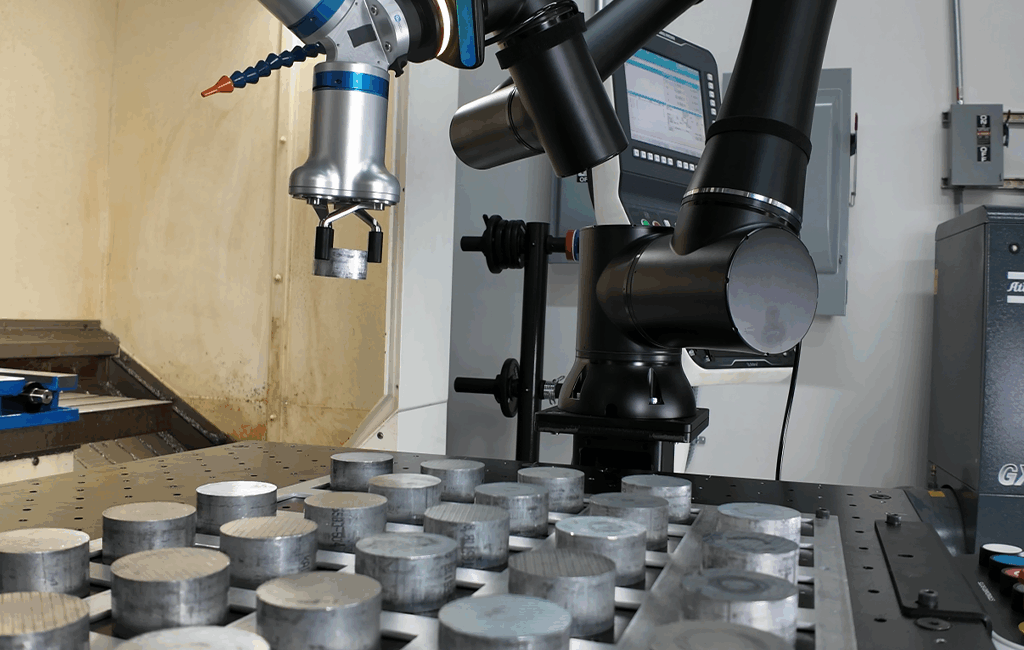
Machine Tending (CNC, Press, Injection Molding)
Industries: Metalworking, plastics, precision machining
Function: Loads/unloads parts, presses buttons, opens doors, and handles hot or sharp parts.
Benefits:
- Handles repetitive, predictable tasks
- Frees human operators for programming/setup
- Reduces injuries and increases uptime
Example: A CNC shop added a cobot to their vertical mill second shift, adding 6 extra hours of runtime daily without hiring additional staff.
Pick-and-Place
Industries: Assembly lines, packaging, sorting, kitting
Function: Moves parts between bins, trays, conveyors, and pallets.
Benefits:
- High repetition with low skill requirements
- Easy to train and adjust
Example: An electronics assembler deployed two cobots to move circuit boards between workstations, reducing transfer time by 30% and minimizing handling errors.
Palletizing
Industries: End-of-line operations across multiple sectors
Function: Stacks boxes or packages consistently on pallets.
Benefits:
- Offloads physically demanding tasks
- Keeps lines running continuously
Example: A food manufacturer replaced a second-shift palletizing position with a cobot, saving $70,000/year in labor while reducing injuries.
Assembly Tasks
Industries: Automotive, electronics, consumer products
Function: Fastens screws, presses parts, applies adhesives, or inserts small components.
Benefits:
- Consistent torque and force
- Reduces fatigue and variability
- Improves product quality
Example: A consumer goods plant used a cobot for final assembly on a packaging line, reducing scrap by 22% and improving cycle time by 14%.
Welding Prep or Spot Welding
Industries: Sheet metal, industrial fabrication, automotive
Function: Tack welds, seam prep, and consistent weld paths.
Benefits:
- Maintains consistent welds
- Offloads tedious work from skilled welders
- Reduces filler material waste
Example: A small fab shop used a cobot to prep weld joints, increasing MIG welder productivity threefold.
Inspection / Quality Control
Industries: Electronics, medical, automotive, food
Function: Vision systems detect defects, confirm alignment, or ensure completeness.
Benefits:
- Reduces eye strain
- Detects micro-defects missed by humans
- Documents every pass/fail
Example: A packaging plant added a vision-equipped cobot for label alignment, cutting rework by 36% and saving 180 hours of manual inspection annually.
What These Tasks Have in Common
Every cobot application shares these characteristics:
- Repetitive and predictable
- Hard to staff consistently
- Physically or mentally taxing for humans
- Measurable ROI in efficiency and safety
These are everyday manufacturing environments, not high-tech, lights-out factories.
A Day in the Life of a Cobot
Consider an 8-hour shift with a cobot on a packaging line:
- Start: Operator loads initial supplies
- First 4 hours: Cobot packs bags into boxes every 8 seconds
- Break: Cobots keep working while humans rest
- Second 4 hours: Consistent performance without fatigue
- End: Operator unloads pallets and resets the line
Results: 2,000+ cycles per day with zero missed cycles, allowing operators to oversee multiple lines.
ROI of Implementing Cobots
Typical benefits observed:
- Payback within 12 months
- Labor savings of $50K–$80K per year per cobot
- Reduced scrap and injuries, improved morale
- Higher uptime, especially on second shifts or weekends
Cobots are redeployable—today they may palletize; tomorrow they might handle assembly or inspection.
Ready to Explore Cobots in Your Facility?
If you’re wondering whether a cobot can help your team, this is your opportunity. Northwest Automation can:
- Walk your floor virtually or in-person
- Identify high-impact use cases
- Build a practical deployment plan
Start seeing what one cobot could do with your team today.